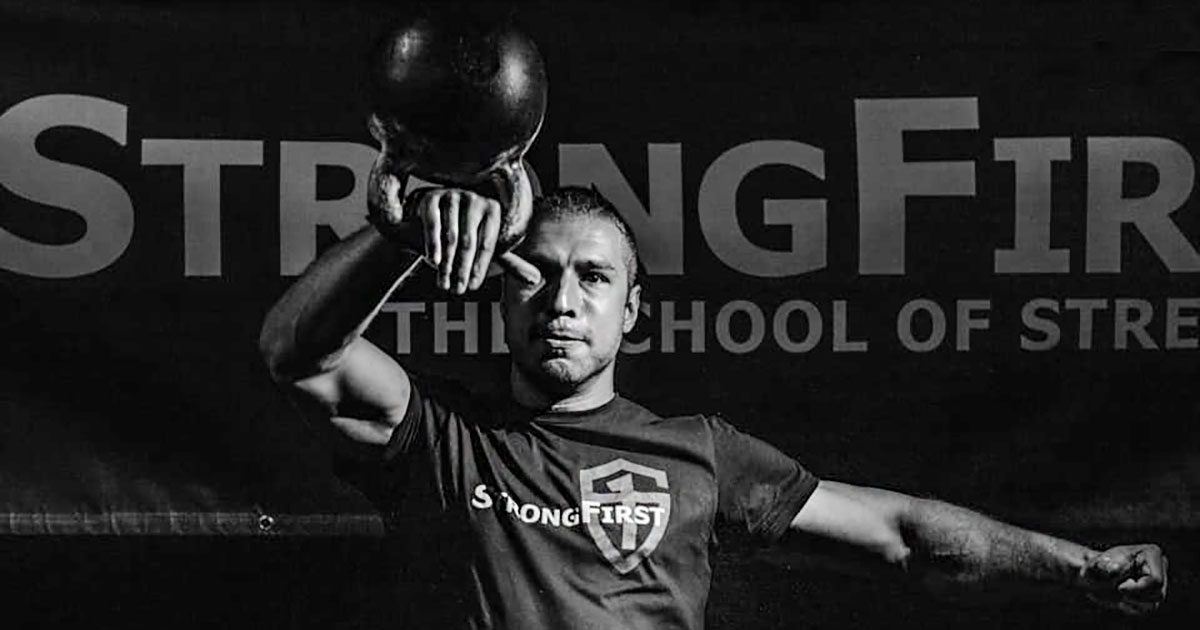
The old-time strongmen who set the bar
The snatch was an Olympic lifting event until 1924, and the old strongmen treated one-arm overhead lifts as showpieces. Herman Görner swung a 50kg kettlebell overhead at 14 and later one-arm snatched 77kg with a thick-handled barbell. Ernest Cadine, a French weightlifter, recorded a 96kg one-arm dumbbell snatch while weighing 85kg. George Hackenschmidt, in his book *Way to Live*, reported one-arm snatching 196 pounds and said several French and German athletes could do about 180 pounds with one hand. These were feats, not training protocols. The kettlebell's fixed weight made single maximum attempts awkward, but its shape allowed swinging between reps, which is why modern heavy snatch training uses moderate loads for multiple fast reps rather than one-rep maxes. The numbers still stand as benchmarks for what the human frame can move overhead.
Why the snatch earns the title 'Tsar'
The kettlebell snatch is often called the Tsar of all kettlebell lifts because it combines the fundamental skills taught at the StrongFirst SFG I certification: overhead mobility and stability, a powerful hinge, and the ability to move the bell in unison with the body. It is not the most democratic exercise—overhead mobility alone keeps many people out—but everyone seeking the SFG I title must work on it at least until they can pass the snatch test. The payoff, as the hard style community puts it, is an iron back, a grip of steel, hard-charging hips, explosive legs, shoulders swelling with muscle, ruthless endurance, and aggressive fat loss. The lift's modern Western form dates to Pavel's introduction a quarter century ago, and the SFG I instructor manual has run through 36 editions since, a sign of how technique keeps evolving as people use the same exercise for different goals—Q&D, AXE, or the TSC Snatch Test.

Heavy is defined by speed, not the scale
Heavy snatch training does not mean finding a one-rep max. The kettlebell's fixed weight makes single maximal attempts awkward compared to a barbell or dumbbell; its shape, however, lets you swing it back between reps, so multiple fast repetitions can be chained. That opened the door to 2-6 rep sets. Under Strong Endurance and its successor AXE, heavy snatches for low reps became a staple, and Harry Westgate's A+A Light program is a recent example from the StrongFirst site. The load should be the heaviest you can accelerate on every rep without losing velocity. If the bell slows down, you're missing the ballistic benefit the snatch is meant to deliver. Heavy, in other words, is relative to your ability to produce power, not to the number on the handle. The kettlebell enforces this by letting the weight swing—you can't cheat with a dead-stop max if you want the benefits of the swing between reps.
Load the hips, anchor the heels
The snatch starts before the bell leaves the floor. In the hinge, load the hips instead of reaching for the kettlebell. That places you anchored to the ground with your heels loaded, which matters the moment the first hike pass begins. A heavy kettlebell moves in front of your body even on a tamed arc; if your weight has shifted to the balls of your toes, that moving mass pulls you forward and out of balance. The setup is not just about generating power; it creates a stable base that can resist the bell's path. Hips stay back, shins stay more vertical than in a squat, and the working arm remains relaxed until the hike. Done correctly, the first rep feels like a loaded spring. Done poorly, every later rep compounds the error. This is why the first repetition is the one that decides whether the set will be powerful or shaky.
Lockout is a standing vertical plank
At the top of a snatch, the torso behaves like a standing vertical plank. This is not a relaxed hold; the asymmetrical load, the bell's velocity, and its weight all increase demand on the body. The vertical plank provides the stability to guide the bell upward and resist its attempt to pull you out of position. With a heavy kettlebell, a small lean appears—but it happens in the ankle, not the spine. The torso stays tall and braced, the shoulder packed, the ribs down. If the lean starts in the lower back, the lift loses its safe structure. This is the same positional standard used in the get-up: the body works as a unit, not a chain of isolated segments. The overhead lockout is the finish, but it's also the checkpoint that tells you whether the rest of the lift was sound. Elbow locked, bicep by the ear, and the bell's handle rotating in the hand. Without adequate shoulder mobility, the lockout will pull the ribs open and the lower back into extension.
Absorb the drop instead of catching it
The return path decides how the next rep feels. StrongFirst Master Instructor Emeritus Brett Jones describes the difference between absorbing and catching the drop. Absorbing means guiding the kettlebell down and back into the hips, so the energy of the drop is caught by the hips, not the arm. This eccentric loading 'loads the spring' and redirects that energy into the next snatch. Catching the drop stops the bell's momentum almost completely; then you have to dead-start the next rep, which costs extra effort and jars the arm and shoulder. The catch also pulls the skin violently as the handle tries to keep falling, creating hand stress and blisters. Absorbing feels like a continuous wave; catching feels like stop-and-go. The technique requires timing and a relaxed enough grip at the right moment. It's the difference between a smooth rep and a series of jerks, and it is what lets heavy snatches flow into set after set.
The heavy single ladder
Another template comes from a bent press discussion Pavel Tsatsouline posted on the StrongFirst forum. Start with a few singles, each heavier than the last, until you reach a comfortable maximum. Then drop to a medium-heavy weight and perform sets of 3-5 reps with a fixed rest interval, up to that day's target volume. StrongFirst Master Instructor Pavel Macek has used this structure in his training log. One coach following it worked up to snatching a 60kg kettlebell, then knocked out 5 singles per side with 56kg, followed by multiple sets of 3-5 with 44kg and 48kg. The singles establish confidence and technique under load; the back-off sets build volume and work capacity without sacrificing speed. The structure is simple, but loading takes judgment: the comfortable maximum has to be one you can move with velocity, not just lift. It resembles the old strongman approach of showing a heavy lift, then doing lighter work to consolidate it.
Speed Metal's one-minute power blocks
Derek Toshner, StrongFirst Certified Master Instructor, built a program to improve snatch power that is part of his Speed Metal curriculum. It centers on heavy singles and doubles done every minute on the minute, a format borrowed from Olympic weightlifting OTM training that traces back to Joe Mills. The short rests keep the nervous system fresh enough to produce maximum velocity on each rep, but they don't allow full recovery, so the work accumulates. This makes it a conditioning test as much as a strength session. Toshner's approach has been tested not only with one-arm snatches; double kettlebell snatches also fit, though that variation is still being explored. If you want to see whether your snatch is genuinely powerful, put your heaviest rep on a timer and see if the second rep moves as fast as the first. The protocol is simple: pick a weight for 1-2 reps, wait a minute, repeat. The hard part is keeping every rep fast.
Laddered heavy snatches
The Variable Method from Strong Endurance offers a way to pack heavy volume into a session. Work in ladders like the Rite of Passage military press program. First ladder: 2 snatches on the right, 3 on the left, 5 on the right. Second ladder: 2 on the left, 3 on the right, 5 on the left. Continue alternating, with each set starting on a fresh minute, for a total of about 100 reps. This protocol lets you use a weight that would normally be too heavy for straight sets because the rep count per side stays low and the changing hands splits the work. Plan Strong's Delta 20 principle tells you when to stop, preventing volume from becoming junk. The ladders combine two things that usually contradict each other: high volume and heavy load. It is not for beginners, but once the technical foundation is laid, it builds both strength and endurance. The exact rep pattern forces equal work on both sides and keeps you honest about pacing.