The Mile 20 Reckoning
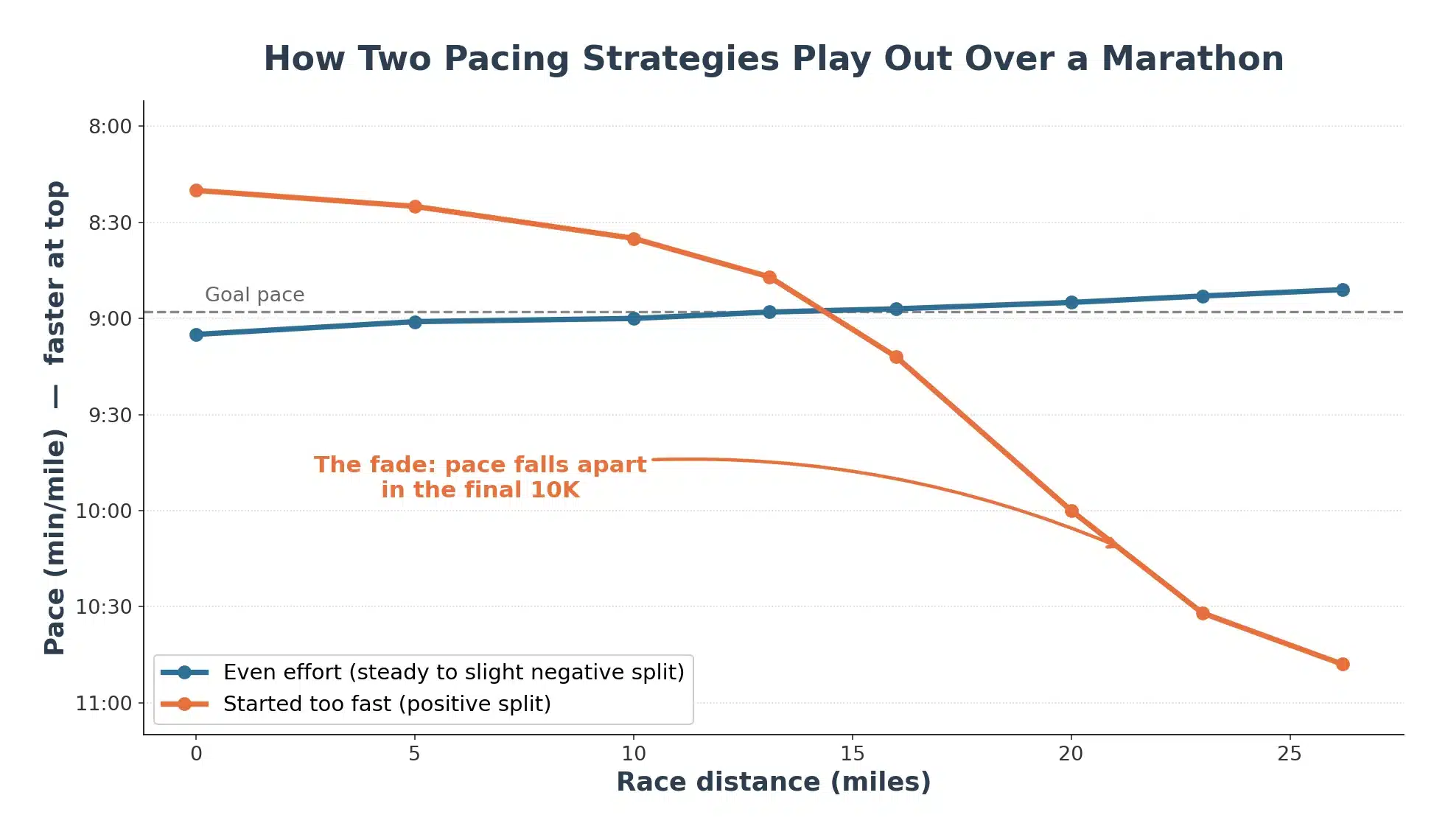
On race morning, the first three miles glide past. Your legs feel light, your breathing easy, and the watch on your wrist says you're 20 seconds a mile faster than your goal. It feels like free time, so you bank it. By mile 20, the bill arrives. The effort you saved in the opening miles now costs double, and the pace you held early turns into a grind. This isn't random: an analysis of more than 300 marathoners found the runners who slowed most in the second half were the younger, less experienced ones who went out too hard. The reason is a gap between the number on the screen and the effort in the body. Most runners can read a pace off a watch; far fewer can feel it. But perceived effort is a reliable substitute — it tracks heart rate at a correlation of 0.74 across 2,560 athletes. That correlation means the effort you sense is backed by the same physiology the watch measures. The fix is to train that internal sense, so the watch confirms what your body already knows — and you don't need a screen to know you're overpaying early.
The Three Meters Inside You
Your body streams effort data on every run, and you can learn to read it. The first meter is perceived effort — how hard the run feels on a 1-to-10 scale. Easy runs sit between 4 and 6, threshold work at 7 to 8, and hard intervals at 9 to 10. Perceived effort tracks heart rate closely, with a correlation of 0.74, making it a reliable proxy for the physiology your watch measures. The second meter is breathing rate. Count the steps you take on each inhale and exhale. A 3-step inhale and a 3-step exhale usually signals easy running; when the pace turns hard, that drops to a 2-and-2 rhythm. The third meter is foot strike rhythm — your cadence. As you speed up, your steps quicken and your foot slaps the ground harder. A good jogging pace, one you can hold while talking in full sentences, combines all three: effort 4 to 6, breathing unhurried, and turnover light. That's the pace for the bulk of your weekly mileage.
Training the Internal Pace Clock
You build a feel for pace the same way you build a feel for anything: guess, check, and close the gap. On your next easy run, before you look at the mile split, call out the pace you think you just ran. Then glance at your watch. The difference between your guess and the reality is your starting error. Within a few weeks of doing this, most runners can name their pace within 10 to 15 seconds per mile. The trick is to treat the GPS as a second opinion, not the primary source. Progression runs sharpen this directly. In a cutdown run, you get quicker as the run goes on, shifting through several paces you train and race at. Each shift forces you to dial in a new pace by feel alone. The repetition of moving through gears teaches your body where each effort sits on the 1-to-10 scale, so that by race day you can settle into the right pace from the first mile without a single glance at the screen.
Race-Day Adjustments That Save Your Second Half
Even a perfectly trained pace needs adjustment for the course and the weather. Elevation changes what a finish time costs you. A 3:55 marathon on a course with 3,000 feet of climbing demands far more fitness than a 3:55 on a flat course like Berlin. Study the profile and break it into segments — put a little extra effort on the climbs and let the pace come back on the descents. Temperature has a similar effect. Warmer temperatures slow marathon times, with the effect growing from 41 to 77°F and hitting slower runners hardest. On a warm day, accept a slightly slower target. Finally, aim for even effort, not even pace. Hold your effort steady and let each mile land within 5 to 10 seconds of your goal, rather than forcing an identical split. The runners who fade at mile 20 didn't plan to fail — they just never learned to feel the pace they were running.