The Talk Test: More Than Five Words Means You're Too Slow
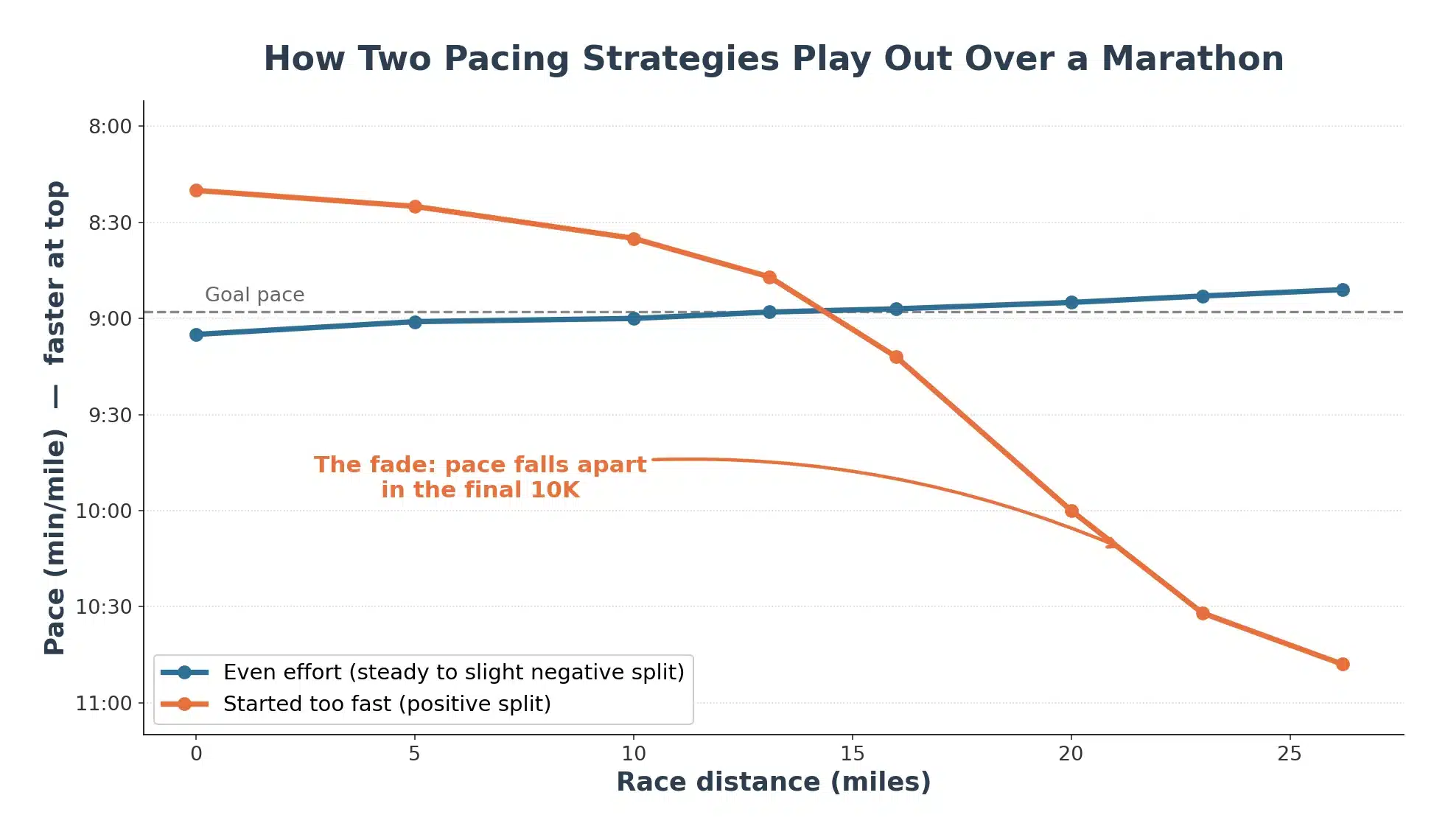
Effort should be prioritized over pace, especially for newer runners, because pace shifts with weather, hills, fatigue, and sleep. The talk test offers a reliable calibration: you shouldn't be able to chat comfortably, but you shouldn't be gasping either. In practice, you can speak short sentences of two or three words—anything more means you're running too slow, while only one or two words signals you've drifted above threshold. This matches the physiology: at tempo effort, lactate production and clearance are balanced, but heavy breathing makes extended conversation impossible. Coaches place this around RPE 7-8, up to 85% of max heart rate, with lactate at 1.0–2.5 mmol/L. The finish-line test confirms it: you should end challenged but confident you could have continued another five to ten minutes. To apply it, start your run at a controlled pace, then check your breath every few minutes. If you can recite a full sentence, speed up slightly; if you're down to single words, back off. Also, beware the deceptively easy first five minutes—resist the urge to accelerate then, or you'll likely fade later.
Jack Daniels' T-Pace: Race-Derived Precision Without a Lab
Dr. Jack Daniels, exercise physiologist, developed the VDOT system to estimate threshold pace from recent race performances. VDOT scores range from 30 to 85, representing a runner's aerobic capacity and running economy, and predict equivalent race times across distances. T-Pace is defined as the fastest pace you can comfortably sustain for about an hour. This pace sits at roughly 85% of maximum heart rate and corresponds to a lactate concentration around the threshold zone. Daniels prescribes sessions based on your VDOT score, eliminating the need for blood lactate testing. Common T-Pace workouts include 20 minutes continuous, 4 x 5 minutes with 1-minute recovery, and 5 x 1 mile with 1-minute recovery. The goal is to improve your body's ability to clear and reuse lactate, allowing you to hold faster paces for longer. Because the pace is derived from a single race result, any recreational runner can plug in their numbers and get specific training targets without a lab.
The Norwegian Method: The 4x4 That Keeps the Sink From Overflowing
The Norwegian method uses laboratory lactate testing — blood lactate measurements in mmol/L — to prescribe threshold sessions with precision. Its most famous expression is the 4 x 4 method: four 4-minute efforts at threshold with 1-minute rests. Total threshold effort usually runs 30 to 50 minutes but is never continuous. The sink analogy explains it: a continuous tempo run is like leaving the tap running until the sink overflows, with lactate building until your legs burn. The Norwegian approach turns the tap on and off, keeping the water level high but never overflowing, so you can accumulate more quality work without hitting exhaustion. Elite long-distance runners use it to rack up mileage without burning out. It's worth trying if you're plateauing on continuous tempo work.
Cruise Intervals: How to Cheat the Mental Grind
Cruise intervals offer an accessible alternative to continuous tempo runs. Popularized by Jack Daniels' threshold research, they break the effort into shorter chunks with a very short recovery jog—30 to 60 seconds—between each. A typical set is 4 x 8 minutes at tempo pace with 90-second easy jog recovery. The name comes from 'cruising' at a controlled, medium-hard effort rather than sprinting. Because the recoveries are short, you can accumulate more total time at threshold than in a single block while keeping your form intact. The Norwegian method similarly uses short intervals with short rests to keep lactic acid at a safe level, allowing you to do more work without excessive fatigue. This structure suits beginners who want tempo benefits without the full 30-minute mental commitment.
How Long a Continuous Tempo Should Actually Be
Continuous tempo is the classic version: a warm-up, one sustained block, then a cool-down. For most runners, the tempo effort itself lasts 20 to 40 minutes, though advanced marathoners can extend toward an hour. The standard structure: 10 to 15 minutes of easy jogging to warm up, 20 to 30 minutes at tempo pace, then 10 minutes easy to cool down. The challenge is psychological — there's no recovery built in, so once you settle into pace, you just hold it. That's why it's a marathon training staple: it builds confidence in holding race rhythm. If you can only manage less than 20 minutes, you're running too fast; shorten the block instead of slowing down the effort. A shorter tempo completed at the correct effort always beats a longer one that's too hard or too slow.
3 Beginner Workouts That Build Up to the Real Thing
Jack Bywater recommends building confidence with shorter tempo efforts or broken chunks before long continuous sessions. Three workouts cover the progression. The 20-minute intro: 10 minutes easy, 10 minutes at tempo, 5 to 10 minutes cool-down. The classic 30-minute tempo: 10 minutes easy, 20 minutes at tempo, 10 minutes cool-down — a staple in half-marathon and marathon plans because it teaches sustained race pace without excessive fatigue. And the 5K-focused session: 2km easy, 3km at tempo pace, easy cool-down. The key is focusing on one consistent effort rather than watching pace. Starting too long is the biggest reason runners hate tempo sessions, so the 10-minute version is the one most beginners should try first. Quality at the right effort beats struggling through a longer block at the wrong one.
The 5 Mistakes That Ruin Every Tempo Run
The most common tempo-killing errors are all pacing-adjacent. Starting too fast tops the list — the first five minutes should feel controlled, even slightly easy, because if you sprint out of the gate, lactate builds fast and the workout becomes a race. Treating every tempo like a race is second: threshold training is most effective when repeatable, so finish able to do a little more, not empty. Running too slowly is the underrated one — holding a full conversation means you're below your lactate threshold. Skipping the warm-up invites injuries and runner's stomach; 10 to 15 minutes of easy jogging plus a few dynamic drills or strides makes the tempo portion feel smoother. Finally, too much of a good thing: most runners should not tempo more than once a week. One easy run, one tempo, one long run is a solid three-run week.
Why One Tempo Run a Week Is the Right Dose
Tempo runs sit between easy runs and intervals in intensity, which makes it tempting to do them constantly. The recovery math argues against it. Most runners benefit from one tempo session per week, alongside lower-intensity mileage that lets the body adapt. A sample week from coaching practice: Monday easy run plus strength, Tuesday tempo, Wednesday recovery run, Thursday strength, Friday rest, Saturday strength, Sunday long run. Tempo runs work well in 5K training and marathon training, but avoid scheduling them right before or after other demanding sessions like hill repeats. Since tempo runs don't feel as brutal as intervals, the recovery cost sneaks up on you — so plan an easy day after. The structure ensures you accumulate quality without carrying excessive fatigue into each session.
Marathon Tempo Runs: Stretching Past the Classic 20 Minutes
For marathon training, tempo runs stretch beyond the classic 20 to 30 minutes. A marathon-specific tempo is 30 to 45 minutes at marathon or threshold effort, preceded by a 15-minute warm-up. These longer sessions teach the body to hold race rhythm and delay fatigue while improving lactate clearance over longer distances. They build endurance and get runners familiar with the sustained discomfort of the final miles. Reserve them — don't rush into long tempos until you've got several shorter sessions under your belt. The payoff is significant: spending 45 minutes at threshold accumulates far more of the adaptation that makes race pace feel manageable. These sessions are best left to runners with experience in tempo work, and they should be booked into weeks where the surrounding mileage is light.