The Freakish Engines
Miguel Indurain, who won five straight Tours de France, reportedly tested at an extraordinary VO2 max. Steve Prefontaine, who held seven American distance records in the 1970s, and Lance Armstrong also posted remarkable values. These are the numbers that dominate all-time lists, with cyclists filling the top tier and a few runners breaking through. VO2 max itself is simple: the maximum volume of oxygen your body can take in and use during hard exercise, measured in millilitres per kilogram per minute. The higher it is, the more oxygen your working muscles can burn to produce energy. Elite male marathoners typically have values that sound lower than those top cyclists but still place them in a separate class from recreational runners. The number is a strong marker of aerobic fitness, but it is not a race predictor. It tells you the size of your engine, not how efficiently you can drive it.
What Sets Your Ceiling
Two physiological factors decide your VO2 max. The first is how much blood your heart pumps to your muscles with each beat. The second is how well those muscles pull oxygen out of that blood and use it. Training-induced gains in VO2 max come mainly from a bigger maximal cardiac output rather than better oxygen extraction. Oxygen delivery is the main limiter for almost every runner. That is why elite runners hold fast paces at relatively low heart rates: their hearts move a huge volume of blood per beat. Genetics set much of your ceiling, which is why middle-distance runners racing from the mile to 10k consistently post the highest values. Sprinters, by contrast, don't rank high because efforts under 20 seconds barely tap the aerobic system. A mile race still involves enough sustained effort to demand maximal oxygen use, while a sprint finishes before your lungs ever catch up.
Where You Land by Age and Sex
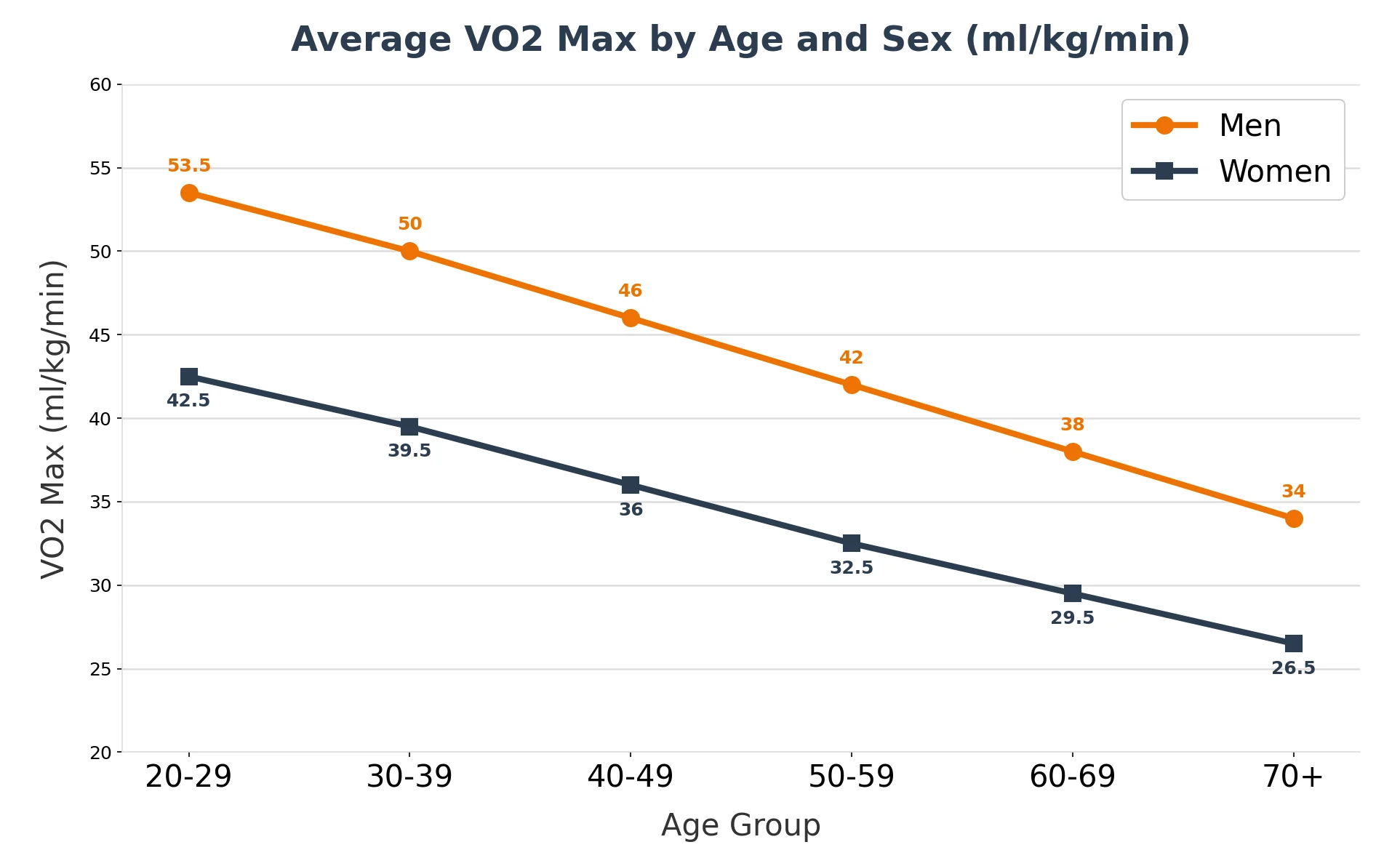
On average, men have a VO2 max of 45 and women 37, with values dropping about 3.5 points per decade after their twenties. Women average roughly 10 to 18% lower than men at the same age, a gap that comes mostly from higher essential fat stores and lower haemoglobin levels, which reduce oxygen-carrying capacity. For healthy, moderately active adults, the typical ranges by age are: 20 to 29, men 52 to 55, women 41 to 44; 30 to 39, men 48 to 52, women 38 to 41; 40 to 49, men 44 to 48, women 34 to 38; 50 to 59, men 40 to 44, women 31 to 34; 60 to 69, men 36 to 40, women 28 to 31; and 70 and over, men 32 to 36, women 25 to 28. Running fitness shifts the numbers upward: a regular runner lands around 55 for men, a competitive club runner around 65, and an elite runner in the 70 to 85 band. Your event matters too—marathoners often post lower values than milers because running economy carries more weight as distance climbs.
Testing and the Heart Rate Shortcut
The gold standard test takes place in a lab. You run on a treadmill wearing breathing apparatus while the speed rises every few minutes for about ten minutes. Your oxygen consumption climbs and then plateaus, and that plateau just before you stop is your VO2 max. Most modern GPS watches from Garmin, COROS, Apple, and Polar estimate VO2 max from your heart rate and pace during normal runs, and for most runners the estimate lands close enough to a lab result to track progress. Treat it as a trend line, not an exact figure. The least reliable estimates come from resting tests that use only heart rate and age, with deviations of around 10%. Heart rate maximum tracks VO2 max closely enough to be useful: 55% of HRmax corresponds to about 40% of VO2 max, 70% to about 60%, 85% to about 80%, and 90% to about 85%. Elite endurance athletes spend about 80% of sessions at low intensity and 20% near 90% of VO2 max. Most runners flip that ratio and spend far too long in the threshold zone, which stalls aerobic gains and raises injury risk. The old 220-minus-age formula for heart rate max often misses by a wide margin.