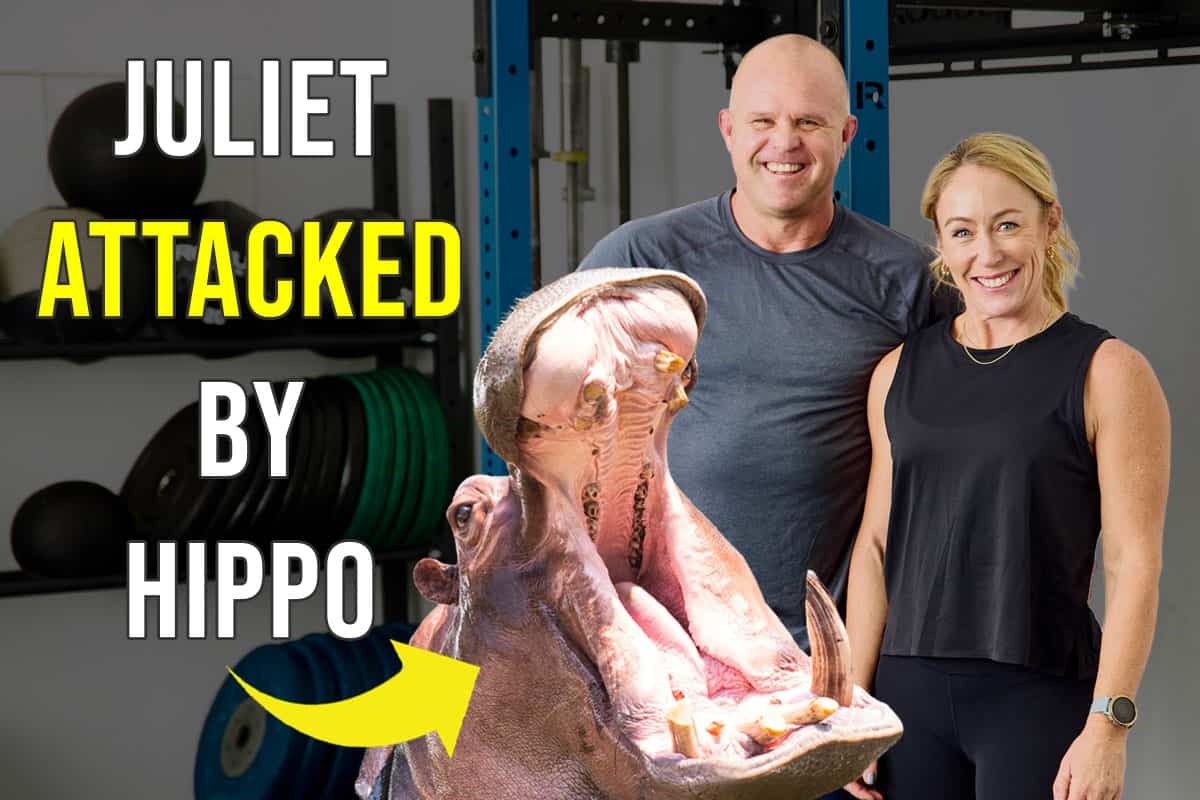
A gunshot sound, a 12-foot flight, and the open jaw of a 4,000-pound hippo
A flat stretch of the lower Zambezi turned into a vertical launch when a hippo came up under Juliet's canoe. The sound, she later said, was like a gunshot. She went twelve feet into the air and, on the way down, looked directly into the animal's open mouth — a jaw backed by roughly 4,000 pounds of muscle. Hippos kill more people in Africa than almost any other large animal, and this attack came without warning. The group hit the water and started swimming for their lives. The seconds after impact, not the launch itself, are what Juliet credits with keeping her alive. She had come from a world of rapids, but none of that covered a hippo. The attack took place in flat water, far from the rapids, which made it harder to process: everything she knew how to read was absent, and the danger was below the surface. The water didn't look dangerous; that was the point.
Tupperware and a Cape Buffalo island: three silent days to the takeout
The aftermath landed the group on an island named for Cape buffalo. Their canoe had taken damage in the attack, and the repair involved Tupperware — a fix that held for the rest of the trip. The remaining paddle to the takeout took three silent days. No one needed to discuss what had just happened; the hippo's size and proximity didn't require commentary. The patched canoe was their only way out, so they stayed in it, moving slowly and quietly. Any splash was a risk. They reached the takeout without another encounter, but the easy-going 'decompress' phase Juliet had signed up for had become a test of nerve. The three days gave her time to replay the launch, the open mouth, and the decision she made in the water. By the time they landed, the safari had stopped being a vacation and started being a survival story.
 Image: thereadystate.com
Gary's safety talk: machetes, three guns, and a vote that almost ended badly
Before the paddling trip set out, guide Gary ran through what he carried: machetes plus three guns, with the list of threats including hippos, crocs, lions, and snakes. Locals already knew not to be in the area, Juliet remembered. When the group reached a stretch dense with hippos, they held a democratic vote to name it — 'Hippo City' or 'Hippo Bronx.' The winning name, taken as a joke, marked the spot where the attack happened. The vote is the kind of decision a group makes when it doesn't yet understand what it's looking at. The locals' absence was the information that mattered, and the team read it too late. Gary's machetes and guns were for emergencies, but no one wanted to find out what counted as one. The briefing made the danger sound manageable; the river made it real.
Two weeks in the Batoka Gorge: daily flips, giardia, and a hundred-degree hike
Daily training in the Batoka Gorge lasted two weeks and ran on a brutal loop: Class V rapids that flipped the boat every day, a dose of giardia that moved through the group, massive crocodiles between rapids, and a hundred-degree hike in and out of the canyon each morning and evening. Early on, the flips were constant. At some point the team found the Nyaminyami — the Zambezi's river spirit — and Juliet treats that as a turning point. The flips began to stop as the team adapted to high-volume water. The heat was its own opponent, a hundred degrees before the first paddle stroke. They learned to read high-volume river features that had no equivalent on the Class IV water most boaters know. By the time the race came, the gorge had become a different place than the one they'd first hiked into.
The Kern River tryout that put a D1 rower in a boat full of legends
Juliet came to whitewater as a Division I rower at Berkeley who had become a wilderness river guide in California, chasing a tan into the sport and staying for the physical test. A tryout on the Kern River led to a Monday phone call that put her on one of the most storied women's extreme whitewater teams in the world. The roster included Kelly Kalafatich, Julie Munger, Beth Rippins, Sue Norman, Brooke Winger, and Rebecca Rusch. Juliet was the youngest and least experienced, and Rusch gave her the nickname 'MEAT' — the middle of the boat, the one with the athletic horsepower. What she lacked in river résumé she made up for in strength and mindset, which is why the team took a chance on her. The 'extreme' in the team's name wasn't decoration; it referred to the rivers they ran.

Five days on flat water at Mana Pools, with Janet aboard
The plan after winning the World Championship was to spend a full month in-country, and the last five days were supposed to be the easy part: a canoe safari at Mana Pools on the lower Zambezi. Flat water, wildlife, no Class V. Juliet's mother Janet joined the trip, which made the stakes personal. The group had already gone through two weeks of training in the gorge; this was the decompression leg. The safari was a reminder that wildlife doesn't run on a schedule or respect athletic résumés. Janet was along for what was supposed to be the calmest stretch of the entire trip. They had budgeted the month, so the safari wasn't an afterthought; it was the reward for the racing. The name Mana Pools promised gentle water, but the wildlife along the banks had other ideas.
Primal terror versus the adrenaline of a Class V rapid
Juliet had spent years in high-stakes athletic environments, but she has said this fear was in a different category. The adrenaline fear of running a difficult rapid comes with the sense that you have some control — you're making moves, reading water, executing. Primal terror, the kind she felt after the hippo attack, is the body taking over before the mind can form a thought. It's the difference between a threat you chose and one that arrives from below the surface. In a rapid, the water's shape tells you what's next; in an attack, there is no shape, no read, no line. The distinction is why she has said she will never do a canoe safari again, no matter how calm the water looks. The fear wasn't in the rapid; it was in the one animal she couldn't see coming.
The split-second water decision that came from years of guiding
What Juliet did in the seconds after hitting the water is the reason she's alive, and she credits years of river guiding for it. The skill wasn't strength or speed; it was not freezing. A guide learns to read a situation and act while the rest of the group is still reacting. In the water, with a hippo somewhere beneath her, that reflex took over. The difference between thinking and moving is the difference between being a victim and being a survivor in that moment. She didn't plan the move; her training made it. Later, she could recall the sound and the mouth, but the decision itself came from somewhere older than memory. It wasn't a calculated choice; it was the accumulated product of every rescue drill, every flipped boat, every eddy she'd ever read. That's why the years of guiding mattered.
A World Championship win, followed by the greatest French fries of Juliet's life
The 1997 Zambezi World Championships ended with Juliet's team winning. After the race, they walked out of the canyon and ate what Juliet still calls the greatest French fries of her life. The victory came in high-volume water that had initially flipped them daily; by race day the runs went clean. The fries were the marker that the hard part was over — a hot, salty celebration after weeks of Class V. No one remarked on the irony of celebrating a world title days before the only attack that would matter. The team had budgeted a full month in-country, so the celebration wasn't the end. The paddling safari that followed was meant to be the reward. It turned out to be the risk. Juliet has never forgotten the taste because it marked the exact moment the fear of the gorge was behind her.
Camel money, helicopter carnage, and four rivers that made extreme whitewater extreme
The late-1990s extreme whitewater circuit Juliet joined ran on Camel Cigarette sponsorships and helicopter-shot footage of carnage on Class V rivers. The sport was high-risk enough that sponsors wanted crashes on camera, and the teams delivered. Juliet competed at four World Championship venues: the Zambezi, the Reventazon, the Orange River, and the Futaleufú. It was at the Chile World Championships on the Futaleufú that she met Kelly, who took what became a famous Class V swim. Helicopters caught the biggest rapids from above, which turned flips and swims into highlight reels. The 'extreme' label wasn't marketing; it was a description of what happened when boats missed their lines. That was the world Juliet was built for — until the hippo.